The Illusion of Ownership: Is Private Property Killing Our Fundamental Rights?
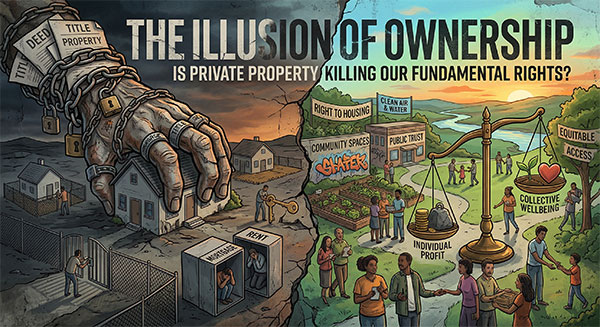
The modern world is built on a single, sacred pillar: the Right to Private Property. We are taught that the "Invisible Hand," as Adam Smith famously suggested, will magically guide the pursuit of individual wealth toward the common good. But as we look at the widening gap between the elite few and the struggling masses, we must ask: Has the "Invisible Hand" become a stranglehold?
1. The Constitutional Conflict
In India, the Constitution guarantees the Right to Life, the Right to Work, and the Right to Natural Justice. However, a capital-driven society creates a fundamental paradox. When resources—land, water, and means of production—are locked behind the gates of private ownership, the "Right to Life" becomes a commodity.
If the state loses control over resources to private interests, it loses the ability to ensure social equity. Can we truly say we have a "Right to Live Peacefully" when our basic survival depends on the profit margins of a private entity?
2. Profit vs. People: The Quality Crisis
In a society obsessed with capital expansion and wealth maximization, quality is the first casualty.
* The Audit Gap: In a profit-oriented setup, state-run quality audits and watchdogs are often sidelined or influenced by the sheer power of private capital.
* The Individualism Trap: Who chooses social welfare over investment maximization? When the system rewards the "slaughter" of the weaker competitor for individual development, collective well-being is viewed as a liability rather than a goal.
3. The Chaos of Unplanned Industrialization
Unplanned industrialization isn't an accident; it is the byproduct of unplanned accumulation. When wealth is concentrated in the hands of a few through unequal distribution and exploitation, the resulting growth is erratic and destructive. It ignores the environment and the dignity of the laborer, focusing solely on the speed of the next return on investment.
4. The "Bread and Circuses" of the Modern Age
How do the masses remain passive while their rights are eroded? We see a sophisticated array of tactics designed to keep the "True Revolution" at bay:
* Freebies and Identity Politics: Using gender, caste, and creed as tools of distraction rather than avenues for justice.
* The Entertainment Opium: A constant stream of movies, religious fervor, and the tribalism of sports like cricket acts as a sedative, ensuring the public stays focused on the screen rather than the scoreboard of social justice.
The Verdict
Capitalism, in its unchecked form, transforms citizens into competitors in a zero-sum game. To reclaim our natural rights—the right to work, to justice, and to a dignified life—we must re-evaluate the supremacy of private property over social responsibility.
Is it time we move away from the "Invisible Hand" and toward a visible heart for our economic policies?
Bharat Asudani - Writer